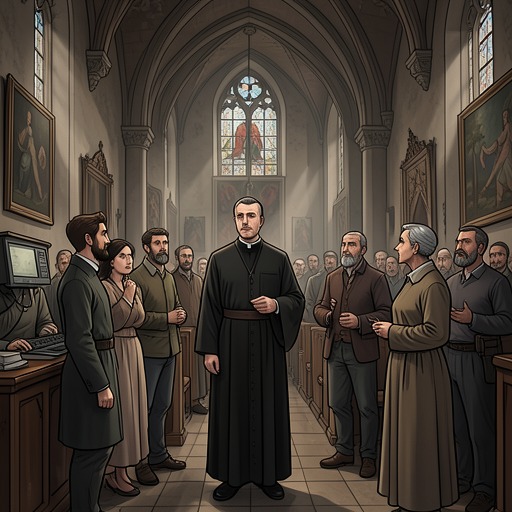
Tonino
The Lying Life of AdultsTonino is Enzo and Margherita’s eldest son, a young man whose reserve and careful speech initially make him seem slight, but whose ambition, fierce loyalty, and capacity for sudden violence make him a consequential presence in Giovanna’s widening family world. He is at once Angela’s boyfriend, Giuliana’s brother, and Roberto’s devoted friend; his relationships link the children of two households already strained by adult betrayals and divided loyalties.
Identity and Introduction
Giovanna first encounters Tonino at Margherita’s home, where Vittoria brings her without warning. He is the eldest of Margherita and Enzo’s three children, tall and handsome, with broad shoulders, curly hair, and a shyness so pronounced that he reddens while shaking Giovanna’s hand and says almost nothing. His likeness to his dead father is especially striking to her: beside a large photograph of Enzo in police uniform, Tonino seems like a living ghost. The resemblance places him in the shadow of a father whose absence remains physically present in the family home.
The household’s first gathering also shows that Tonino’s quietness does not mean passivity. While Corrado entertains Giovanna with compliments and Margherita repeatedly tells him to leave the girl alone, Tonino overwhelms her with quiet courtesies. Later, when a guest is unwelcome, he and Giuliana turn to Vittoria to settle the dispute. At Vittoria’s suggestion that Corrado sleep at her house instead, the family’s gratitude is immediate; Corrado, after scowling and resisting, kisses Vittoria repeatedly on the neck and cheek. Tonino’s place in this intimate, complicated family is established through gestures of deference and affection rather than explanation.
Family, Work, and Ambition
As Giovanna comes to know the relatives she had barely met before, Tonino belongs to a world that had seemed distant from her parents’ familiar neighborhoods above the city. The journey into his family’s part of Naples passes through bleak apartment blocks, industrial sheds, garbage-strewn patches of green, and puddles left by rain. That geography carries the weight of a family separation: Giovanna’s father describes having grown up in the neighborhood, while his daughter discovers the relatives from whom she had been kept at a distance. Within those homes, the relatives welcome her warmly, even as Vittoria urges her to look closely at the differences between the two sides of the family.
Tonino’s life is not confined to the modest work he has already found after earning a surveyor’s diploma. Angela describes him as working a little while secretly studying architecture, without even telling his mother or siblings. During a long walk beside the sea, Tonino tells Giovanna in detail about a difficult examination he has passed brilliantly. His measured manner, which can frustrate Angela, becomes a source of interest to Giovanna: he weighs his words and gestures, but what he says rewards her patience. His private studies reveal a sustained ambition pursued without public announcement.
Angela and Roberto
Tonino’s relationship with Angela is affectionate but strained by their different temperaments. Angela tells Giovanna that he lets her order him around because he loves her, yet can stand up to anyone who tries to dominate him. He comes to meet her at school every day. To Angela, his slow, deliberate way of talking can be exasperating; to Giovanna, it makes him seem thoughtful and gives their conversations room to unfold. Angela’s account also presents him as handsome and physically strong, with broad shoulders and visible muscles even under a jacket.
Tonino’s friendship with Roberto offers another measure of his character. Though the two men are very different, Tonino speaks of Roberto with unqualified respect and no apparent envy. On the walk with Giovanna, he describes Roberto as good, modest, and able to animate even people who have lost heart; he also reports Roberto’s promising academic career and recent publication in a prestigious international journal. Angela jokes that Giuliana should not be engaged to Roberto but that Tonino should be, because Tonino’s admiration is so evident. Tonino’s response, as Giovanna hears it, is not rivalry but a sincere devotion to his friend’s qualities. His account also explains that Giuliana would like to join Roberto in Milan, but Vittoria has turned Margherita against the plan, and the family now wants the couple to marry first.
Angela, the Cinema Fight, and Departure
Tonino’s restraint proves vulnerable to insult and provocation. At the cinema, Angela is irritated by boys in the audience who bother her and Giuliana. She tells Tonino that she is fed up and no longer wants to go out with him; when one of the boys celebrates the prospect of her leaving him, Tonino first tries to move the group farther down the theater. The boys follow and taunt him for letting Angela order him around. As the film begins, Angela repeats the insult that one boy has directed at Tonino. He abruptly slaps her, hard enough that her head strikes Giovanna’s cheekbone, then turns on the boy. After grabbing him and punching him beneath the chin, Tonino continues striking him as the theater erupts in shouting. Giuliana, Giovanna, and Angela pull Tonino away and get him to the exit; he leaves toward Piazza Dante, still insisting that a respectable person should be able to watch a film in peace. His response transforms the self-command Giovanna had admired into an episode of violence that injures Angela and alarms the people trying to stop him.
Tonino’s abrupt departure follows soon afterward. He calls Giovanna at home, apologizes, and says goodbye: he is going to Venice. The calm, deliberate manner in which he speaks contrasts with the fury of the cinema fight, though the evidence gives no further account here of what prompted his move. Later, when Giovanna is preparing to travel to Venice with Ida, she calls Tonino at the restaurant where he works. He initially sounds happy about the plan, then points out that his small room in Mestre cannot accommodate three people. Giovanna says that she and Ida are coming to see him regardless, whether or not he chooses to spend time with them. Tonino changes his tone, says he is glad, and agrees to expect them. The exchange leaves their reunion open to choice: the room is too small to house all three, but not too small a reason to refuse the visit.
Giovanna’s Changing View of Tonino
Giovanna’s first impressions are colored by the novelty of meeting her father’s relatives, whom she had known only from rare, awkward family occasions. Vittoria takes her to their homes without warning, and the relatives welcome her with an ease that makes her feel unexpectedly open and affectionate. They call her Giannina, a name her parents and school friends do not use; in their company she begins to imagine herself as a different, more relaxed person. Tonino is part of this newly discovered circle, but at first he seems the least substantial of Margherita’s three children. As Giovanna retells the visits to Angela and Ida, however, she finds herself dwelling on him, embellishing his appeal until Ida identifies her supposed feelings as love. Giovanna admits it, partly to see Angela’s reaction, and recognizes that her growing attachment is entangled with the stories she is making up about this family.
That invention creates a private boundary. Angela and Ida want to meet Vittoria and Tonino, but Giovanna refuses: she wants to preserve the world as something of her own, fearing that actual contact will seem poorer than the version she has narrated. Meanwhile, Vittoria presses her to take sides between the newly discovered relatives and her parents. Giovanna feels caught between competing demands and begins, almost without realizing it, to spy on her parents. Tonino’s place in her imagination thus grows during a period when she is not simply discovering him but using the family’s stories to negotiate belonging and divided loyalties.
Angela’s Relationship and Giovanna’s Attachment
When Angela later confides that she and Tonino are in love, the disclosure unsettles the earlier fantasy. Angela says Tonino calls her often, meets her in Posillipo, walks with her in Mergellina, and declared his love less than a week before their conversation. She also tells Giovanna to keep the relationship secret. Giovanna says little, concealing her irritation that Angela is going out with Tonino, and insists that she had only been joking when she said he liked her. The contrast is pointed: Giovanna has helped turn Tonino into an object of romantic storytelling, while Angela describes an actual relationship unfolding beyond Giovanna’s reach.
Angela presents Tonino as a boyfriend who lets her order him around because he loves her, yet can assert himself against anyone who tries to dominate him. He meets her at school every day. She admires his looks and strength, and describes his slow, spare speech as meaningful: he may say little, but what he says matters. Giovanna listens to this portrait without being persuaded that Angela’s happiness is as uncomplicated as she claims. She suspects Angela may be emphasizing the relationship to show that she remains happy despite her parents’ separation. The two girls’ competing accounts make Tonino a measure of their own feelings as much as a subject in his own right.
Giovanna’s attraction becomes more grounded during a walk along the sea from Mergellina toward the Palazzo Reale. With Angela beside them, she questions Tonino closely and finds his deliberate speech engaging rather than frustrating. He explains his secret ambition to become an architect, describing in detail a difficult examination he has passed brilliantly. Giovanna also learns that since Don Giacomo had to leave the parish, Vittoria has become more unbearable and has made life difficult for the family. Tonino’s account gives his quietness substance: behind his measured words are private plans, study, and a candid view of the tensions at home.
The same conversation deepens Giovanna’s understanding of Tonino through his regard for Roberto. Tonino speaks of his friend with unmistakable affection and respect, describing him as good and modest, with an energy that lifts even the disheartened. He mentions Roberto’s promising university career and a recently published essay in a prestigious international journal. His admiration carries no sign of envy or malice, despite Giovanna’s observation that Tonino is more handsome and, in her view, more intelligent than Roberto. When Angela teases that Giuliana should be engaged to Tonino instead, Tonino’s praise has already made clear that friendship, rather than rivalry, is the defining feature of his attachment to Roberto.
Violence, Departure, and the Possibility of Reunion
Tonino’s reserve proves vulnerable to insult and provocation. At the cinema, Angela grows angry with boys who bother her and Giuliana. She tells Tonino she is fed up with him; when one of the boys welcomes the prospect of her leaving, Tonino first tries to move the group farther down the theater. The boys follow and taunt him for letting Angela order him around. As the film begins, Angela repeats the insult one of them has directed at Tonino. He abruptly slaps her, hard enough that her head strikes Giovanna’s cheekbone, then turns on the boy. He grabs him and punches him beneath the chin, continuing to hit him as the theater erupts. Giuliana, Giovanna, and Angela pull Tonino away and lead him out. Running toward Piazza Dante, he insists that a respectable person should be able to watch a film in peace. The violence sharply unsettles the image of the patient, careful young man: his defense of his dignity injures Angela and leaves the others trying to restrain him.
Soon afterward, Tonino calls Giovanna at home to apologize and say goodbye. When she asks where he is going, he answers, Venice. His calm, measured manner contrasts with the fury of the cinema fight, but the account does not establish that the fight caused his departure. Later, as Giovanna prepares to travel to Venice with Ida, she calls him at the restaurant where he works. He initially seems pleased by the plan, but says that his small room in Mestre cannot accommodate three people. Giovanna replies that she and Ida are coming to say hello regardless, and that they will manage if he does not want to meet them. Tonino then changes his tone, says he is glad, and agrees to expect them. The exchange leaves the reunion contingent on his welcome: his room is too small for three, but he does not let that become a reason to refuse their visit.
Across these episodes, Tonino’s character emerges through contrasts rather than a single settled portrait. He is shy and deliberate in conversation, secretly ambitious in his studies, and generous in his unjealous admiration of Roberto; with Angela, he is loving but capable of force that crosses into harm. His departure to Venice interrupts the relationships formed in Naples without resolving them, while his eventual agreement to welcome Giovanna and Ida leaves a modest opening for renewed contact.